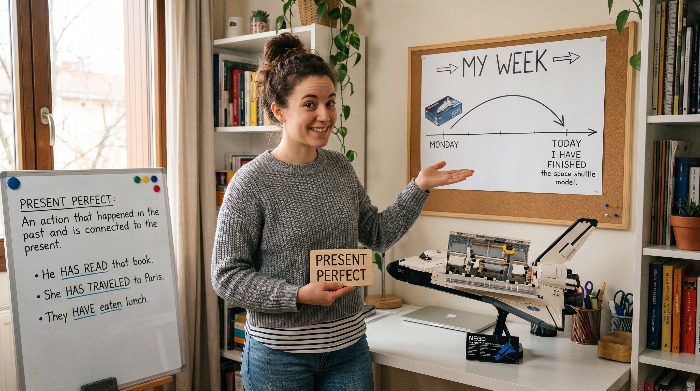
This lesson explains the present perfect in clear, practical English.
Use it for past actions connected to now, life experience, recent news, and unfinished time.
The main form is: Subject + have or has + past participle.
Common time words include already, yet, just, ever, never, this week, so far, recently.
You will study affirmative sentences, negative sentences, questions, common mistakes, and useful examples.
By the end, you should be able to recognize the tense and use it in real sentences.
Overview
The present perfect gives a sentence a specific time meaning. It is not only about the verb form; it also tells the listener how the action connects to time, routine, progress, completion, or duration.
When learners use this tense well, their sentences become clearer because the reader knows whether the action is normal, finished, happening now, completed before another time, or continuing for a period.
Start by learning the pattern, then connect the pattern to real situations. Grammar becomes easier when each form has a clear reason.
Subject + have or has + past participle
Common Time Words
already
yet
just
ever
never
this week
so far
recently
Forms
The form of a tense is the grammar structure you use to build sentences. Study affirmative, negative, and question forms together so you can change a sentence quickly.
Affirmative
Use have with I, you, we, and they. Use has with he, she, it, and singular nouns.
I have opened the file.
Lina has opened the file.
The students have opened the file.
Negative
Place not after have or has.
I have not opened the file.
Lina has not opened the file.
The students have not opened the file.
Question
Move have or has before the subject.
Have you opened the file?
Has Lina opened the file?
What have the students opened?
Main Uses
The present perfect appears in many real conversations, lessons, stories, emails, and tests. The key is to choose it because the meaning needs this tense, not only because a time word appears.
Use it to talk about experiences without saying exactly when they happened.
I have visited Istanbul.
He has never eaten sushi.
Have you ever met a famous person?
Unfinished Time
Use it with time periods that continue to now.
I have sent three emails today.
We have learned two tenses this week.
The company has hired five people this year.
Examples
Read these examples aloud. Notice how the helping verbs and main verbs change in each sentence type.
Affirmative
I have finished the report.
She has written the email.
They have visited London.
Negative
I have not finished yet.
He has not driven today.
They have not seen the film.
Question
Have you studied today?
Has Maya arrived yet?
Where have they gone?
Mini Paragraph
In real English, this tense usually appears inside a longer message. A learner might use it to explain a routine, tell part of a story, describe a plan, or connect one action to another time. The goal is not to memorize one sentence, but to understand why the tense fits the meaning.
Common Mistakes
Most tense mistakes happen because learners mix the auxiliary verb, the main verb form, or the time meaning. Slow down and check each part of the sentence.
Do not use a finished time word with present perfect.
Say "I saw him yesterday", not "I have seen him yesterday".
Use the past participle, not the past simple form for every verb.
Say "has written", not "has wrote".
Remember has with singular subjects.
Say "She has finished", not "She have finished".
Teacher tip: Ask two questions when checking your answer: What time does the action belong to? What form does this tense need?
This article provides a comprehensive, all-in-one guide to the passive voicein English, designed for intermediate learners at levels B1 to B2 who want to understand when
This article provides a comprehensive, all-in-one guide to the passive voicein English, designed for intermediate learners at levels B1 to B2 who want to understand when