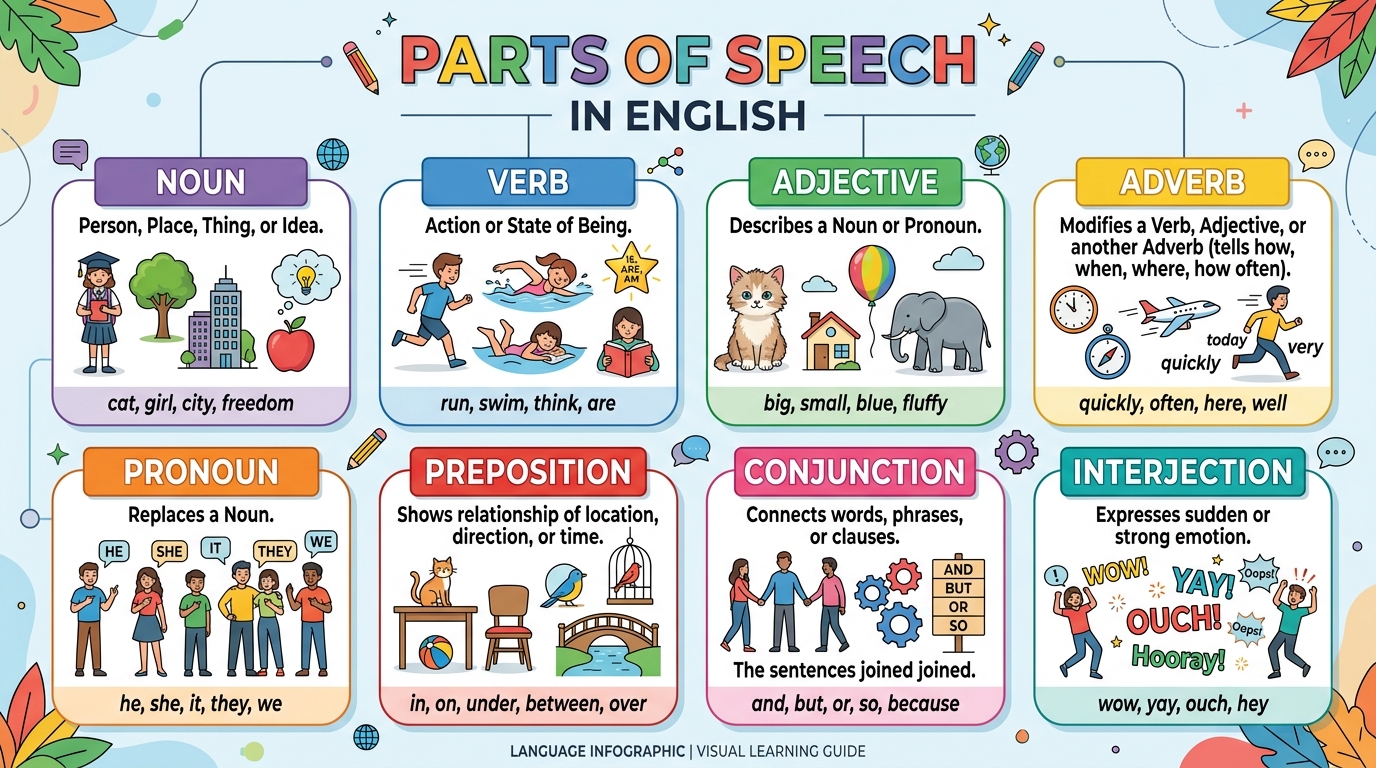
The English language is composed of various elements that work together to form meaningful sentences. These elements are known as the parts of speech. Understanding the parts of speech is essential for mastering the language, as they serve different roles in a sentence. Each part of speech contributes to the overall meaning and structure of our communication. In this lesson, we will explore the eight main parts of speech—nouns, pronouns, verbs, adjectives, adverbs, prepositions, conjunctions, and interjections. By the end of this comprehensive guide, you will understand not just what these words are, but exactly how they work together to create clear, effective, and natural-sounding communication.
Nouns: The Anchors of the Sentence
Nouns form the foundation of English sentences by naming people, places, things, or abstract ideas. Think of them as the primary subjects and objects of your statements. For example, words like cat, city, and happiness are all nouns. When we refer to general, everyday items, we use common nouns, such as a dog or a teacher. However, when we specify a unique, distinct entity, we use proper nouns. Proper nouns must always be capitalized regardless of where they appear in a sentence, such as naming a specific place like New York or a specific person like John.
Furthermore, English distinguishes between physical objects and intangible concepts. We use concrete nouns to describe things that can be seen or touched, like an apple or a table. In contrast, abstract nouns are used to name ideas, qualities, or emotions that lack physical form, such as love, freedom, or courage.
Pronouns: Avoiding Repetition
To prevent our spoken and written English from sounding unnatural and repetitive, we rely heavily on pronouns to take the place of nouns. Instead of repeating a person's name multiple times in a single paragraph, you can substitute it with personal pronouns such as he, she, it, or they.
Pronouns also help us establish relationships between people and objects. When you need to demonstrate ownership, possessive pronouns like my, your, or his are utilized. In cases where the subject of the sentence is also the receiver of the action, reflexive pronouns like myself or yourself become necessary. Finally, relative pronouns such as who, which, and that serve as vital connectors, linking different clauses together to seamlessly form complex sentences.
Verbs: The Engine of Action
A sentence cannot exist without a verb. Verbs act as the engine of your sentences, expressing actions or states of being. Words like run, think, jump, and become dictate what is happening in your statement. The most common type are action verbs, which describe physical or mental actions such as to swim or to believe. Instead of showing action, linking verbs connect the subject of a sentence to additional information about that subject, utilizing forms like am, is, or are.
Verbs are further divided by how they interact with objects. Transitive verbs require a direct object to make sense; for example, the word eat in the phrase "She eats an apple" transfers the action directly to the apple. Intransitive verbs, on the other hand, do not require a direct object, such as the word sneeze in the complete thought "He sneezed."
Adjectives: Adding Color and Detail
Adjectives are descriptive words that modify or provide more information about nouns. They add color, size, and detail to your sentences with words like blue, quick, large, and bright. Descriptive adjectives directly explain the qualities of a noun, telling us that a tree is tall or a meal is delicious.
When you need to indicate amounts without using exact numbers, quantitative adjectives like some or many are used. To point out specific nouns in a physical space, English relies on demonstrative adjectives such as this or those. Finally, possessive adjectives function similarly to possessive pronouns by modifying a noun to show exactly who owns it, using words like my book or her car.
Adverbs: Modifying the Action
While adjectives modify nouns, adverbs are designed to modify verbs, adjectives, or even other adverbs. They provide crucial context about the action taking place and very frequently end in the suffix "-ly," as seen in words like quickly, silently, and happily.
Adverbs answer important questions for the reader. They describe the manner in which something is done (e.g., walking slowly or carefully). They establish time, telling us when an event occurs, such as yesterday or soon. They also clarify frequency, indicating how often a routine happens using words like always or sometimes. Lastly, adverbs of place describe where an action is occurring, such as looking here or searching everywhere.
Prepositions: Establishing Relationships
Prepositions are positional words that show the relationship between a noun (or pronoun) and other words in a sentence. They are essential for grounding your sentences in time and space using small but powerful words like in, on, at, between, and under.
Prepositions can indicate time boundaries, such as stating "We will meet at noon." They are heavily used to establish place or location, showing us that "The cat is under the table." Prepositions also dictate direction of movement, like walking to the store, and can even establish abstract relationships, such as discussing a book about history.
Conjunctions: Building Complex Thoughts
Conjunctions are the glue that holds English sentences together. They connect words, phrases, or entire clauses, allowing you to build complex and fluid thoughts instead of speaking in short, robotic sentences. Common examples include and, but, or, because, and although.
There are three main categories of conjunctions. Coordinating conjunctions connect words or groups of words that carry equal grammatical weight, using familiar connectors like and, but, or so. Subordinating conjunctions are used to connect an independent clause with a dependent clause, establishing a relationship of cause and effect or condition with words like although, because, or if. Finally, correlative conjunctions work in specific pairs to join elements, such as using both...and, either...or, or neither...nor.
Interjections: Expressing Emotion
Interjections stand apart from the other parts of speech because they are not strictly grammatically related to the rest of the sentence. Instead, interjections are used to express strong emotions, sudden feelings, or reactions. They are often followed by an exclamation point and include words like oh!, wow!, ouch!, and yay!.
Depending on the context, interjections can convey a wide range of human experiences. They can show surprise ("Wow! That's amazing!"), express physical pain ("Ouch! That hurt!"), demonstrate intense joy ("Yay! We won!"), or indicate sudden disappointment or realization, such as saying, "Oh, I forgot!"