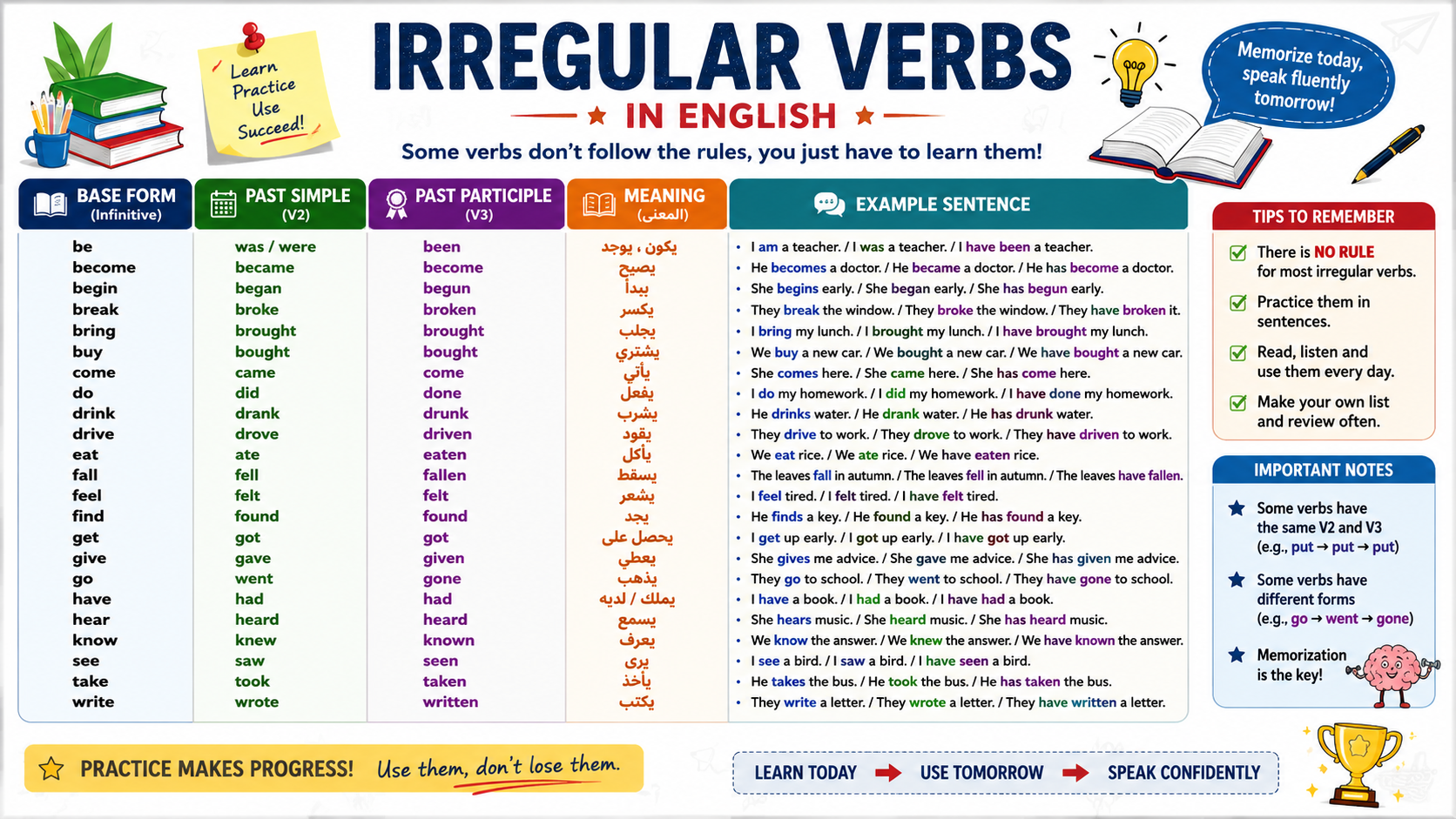
Irregular verbs are one of the most important parts of learning English because they are used frequently in everyday conversations, writing, and reading. Unlike regular verbs, irregular verbs do not follow the common rule of adding -ed to form the past tense and past participle, which makes them more challenging for many learners.
To help learners master these essential verbs, we have created a complete collection of the most common English irregular verbs with their different forms, including the base form, past simple, and past participle. The tool also provides example sentences to show how each verb is used in real situations, making it easier to understand the meaning and remember the correct form.
This tool allows users to explore irregular verbs in different ways according to their learning style. You can display the verbs automatically, view them in an organized table, or browse them as a simple list. You can also hide and reveal words or sentences, making it useful for practice, self-testing, and improving your English grammar and vocabulary.
Irregular Verbs Sort Tool
TableCardsSlideshowMemoryTopicsSubtopicsView:Voice:Count:GenerateManualAutomaticDelaySlide DelayColumn PauseAuto voice onAuto voice offAuto read aloud👁️ Show Columns:🔊 Read Columns (TTS):Card @current of @totalPreviousNextStart AutoManual modePauseResumeAutomatic mode is runningAutomatic mode is pausedListenLoading...Error: Could not load data.Please select at least one topic and one subtopic.No data found.No valid data found.Select at least one topic and one subtopic before generating.Word BuilderLoading vocabulary data...Start GameScore:Form words from:TYPE HERE...Submit AnswerGame OverYou scored:You found:Required words missed:Play AgainNo Word Builder data found for this topic.Ready! Loaded @count words.Already found!Invalid Letters!Valid! +1Not in answer key!Checking...Bonus Word! +1Not an English word!Accepted! +1Out of Lives!Perfect!Time's Up!NoneNone! You found all required words!Daily HighlightLoading today's phrase...Related / Translations:Show More SubtopicsShow LessMemorize the answers!Word ChainStart with the last letter of the system's word.No duplicate words allowed.Words must be at least @len letters long.System Played:Your turn! Starts with:Submit WordWord History:SystemYouWords Chained:You ran out of time!You Win!The system ran out of words starting with '@letter'!Word type must be: @posMust be: @pos!HangmanGuess the word!Word was:Correct! 🎉Spelling BeeLoading vocabulary...StartType what you hear...CheckNext WordFinished!Ready! @count words loaded.No valid words found.Incorrect.Correct answer:Game Over!Moves:Matches:You won in @moves moves!Stop AudioReading Voice:Volume:Vocabulary Dictionary:Copy AllInteractive Reading AssistantRead ThisCopied!My Unknown WordsCopy List to ClipboardClick any word in the text below to view its translation and save it to your unknown words list.No definition found in database.Letter HiveWords Found:Invalid letters used!Word too short!Already found!
English Vocabulary
| Base | Past | Past Participle | Phrase |
|---|
| Meet | Met | Met | We met at the coffee shop. |
| Lay | Laid | Laid | She laid the book on the table. |
| Pay | Paid | Paid | He paid the bill with his credit card. |
| Bet | Bet | Bet | I bet all my money on that horse. |
| Dream | Dreamt/Dreamed | Dreamt/Dreamed | I dreamt about flying last night. |
| Hang | Hung | Hung | I hung the painting on the wall. |
| Leave | Left | Left | They left the house early. |
| Come | Came | Come | He came to my house last night. |
| Put | Put | Put | She put the groceries in the fridge. |
| Steal | Stole | Stolen | Someone stole my bicycle yesterday. |
| Hit | Hit | Hit | The car hit the street lamp. |
| Sew | Sewed | Sewn | She sewed a button on my shirt. |
| Drink | Drank | Drunk | He drank a glass of cold water. |
| Find | Found | Found | I found my lost keys under the sofa. |
| Broadcast | Broadcast | Broadcast | They broadcast the news live. |
| Run | Ran | Run | The dog ran away from the yard. |
| Send | Sent | Sent | I sent you an email this morning. |
| Forgive | Forgave | Forgiven | She forgave him for his mistake. |
| Hold | Held | Held | She held the baby safely in her arms. |
| Bring | Brought | Brought | I brought some snacks for us. |
How to Learn and Remember English Irregular Verbs Effectively
Learning irregular verbs requires regular practice because there is no single rule that applies to all of them. The best approach is to start with the most common verbs used in daily English, such as be, have, do, go, get, make, take, and see, and gradually add more verbs as your knowledge improves.
Instead of memorizing a long list without context, try learning each verb with an example sentence. Understanding how a verb is used in real communication helps your brain remember it more easily. Reading, listening, and creating your own sentences using irregular verbs will make your learning process faster and more effective.
Reviewing irregular verbs regularly is essential for long-term memory. Use this tool to test yourself, hide the answers, and try to remember the correct forms before revealing them. With consistent practice, irregular verbs will become familiar, and you will use them naturally when speaking and writing in English.