

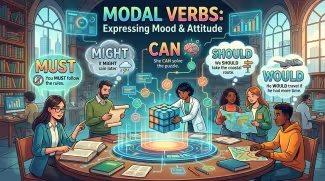


This article provides a comprehensive, all-in-one guide to English modal verbs

This article provides a comprehensive, all-in-one guide to the verb

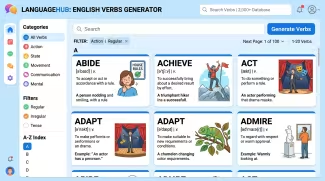
Master the 2,000 most common English verbs with this smart and interactive learning tool.

The English language is composed of various elements that work together to form meaningful sentences. These elements are known as the parts of speech.

Past Perfect

The Past Perfect tense acts as the ultimate "past in the past" for complex storytelling. It clarifies which of two past actions happened first, preventing timeline confusion. To form it, writers combine the auxiliary "had" with the past participle of the main verb. Without this tense, establishing a clear chronological narrative can become incredibly difficult. It often relies on conjunctions like "before," "after," and "by the time" to show relationships. Review this summary to unlock the secret to writing sophisticated, multi-layered past narratives.

Object Pronouns in English

Beginner Grammar A0

In this article, Beginner Grammar A0 learners study object pronouns.

You will learn which pronouns appear after verbs and prepositions.

The key question is: Who or what receives the action or follows the preposition?

The main rule to remember is: A noun can be singular or plural, common or proper, concrete or abstract, countable or uncountable.

Adverbs of Manner Explained

Beginner to Elementary Grammar A1

In this article, Beginner to Elementary Grammar A1 learners study adverbs of manner.

You will learn how to describe the way an action happens.

The key question is: How does someone do the action?

The main rule to remember is: Place the adverb where it clearly connects to the word or idea it modifies.

Past Perfect Continuous


This lesson explains the past perfect continuous in clear, practical English.

Use it for actions that continued up to another past action or past time.

The main form is: Subject + had been + verb-ing.

Common time words include for two hours before, since morning when, all day before, by the time, before the meeting.

You will study affirmative sentences, negative sentences, questions, common mistakes, and useful examples.

Subject Pronouns in English

Beginner Grammar A0

In this article, Beginner Grammar A0 learners study subject pronouns.

You will learn which pronouns can act as the subject before a verb.

The key question is: Who or what does the action in the sentence?

The main rule to remember is: A noun can be singular or plural, common or proper, concrete or abstract, countable or uncountable.

Adverbs of Frequency Explained

Beginner to Elementary Grammar A1

In this article, Beginner to Elementary Grammar A1 learners study adverbs of frequency.

You will learn where to place always, usually, often, sometimes, rarely, and never.

The key question is: How often does the action happen?

The main rule to remember is: Place the adverb where it clearly connects to the word or idea it modifies.

English Grammar Guide: Demonstratives (This/That/These/Those), Possessives, and "There Is/Are"

Understanding how to point out specific objects, express ownership, and state existence are essential milestones in learning beginner English grammar. This comprehensive guide breaks down the critical differences between the demonstrative words "this," "that," "these," and "those," teaching you how physical distance dictates their use. You will also learn how to properly apply possessive adjectives (my, your, his, her) to indicate ownership without confusing them with pronouns.

This article provides a comprehensive, all-in-one guide to English inversion — one of the most sophisticated and elegant structures in the language.

This article provides a comprehensive, all-in-one guide to English inversion — one of the most sophisticated and elegant structures in the language.

This article provides a comprehensive, all-in-one guide to English inversion — one of the most sophisticated and elegant structures in the language.

This article provides a comprehensive, all-in-one guide to English inversion — one of the most sophisticated and elegant structures in the language.

This article provides a comprehensive, all-in-one guide to the passive voice in English, designed for intermediate learners at levels B1 to B2 who want to understand when

This article provides a comprehensive, all-in-one guide to the passive voice in English, designed for intermediate learners at levels B1 to B2 who want to understand when